An actuary sets a reserve her regulator will examine. A compliance officer signs a statement that a shipment of cocoa never touched cleared forest. A claims officer in Madhya Pradesh approves a payout on a failed harvest. Three industries, three regulators, no shared language between them, and underneath, the same job: take something a satellite saw, fuse it with everything else that senses, and turn it into a number somebody else will hold them to.
Every Earth observation company has the slide: the capability in the middle, arrows out to insurance, agriculture, defence, carbon, infrastructure. The same product pointed at every industry, on the theory that pixels do not care where they land, and a market size that is the sum of the arrows. Everyone also knows how it usually ends: a pilot that impresses for a year and converts to nothing. The arrows fail because they land in jobs, and the jobs are not interchangeable. I mapped them, arrow by arrow, from insurance to deforestation compliance to defence: roughly seventy-five jobs that buyers answer for, each checked against live sources. Underneath there are about five.
You watch a thing against its own past. You surface an anomaly for somebody to act on. You turn an observation into a number defensible enough to carry a decision you answer for. You confirm a claim somebody else has made. You author the rule everyone else is held to. That is the whole catalogue. A single crop field passes through four of the five in one season: week to week it is the agronomist’s own business; at claim time it becomes a yield the insurer must defend to the state; inside a subsidy check it is evidence in someone else’s verification; and the formula that settles all of it is a rule the government authored. Same field, same pixels. Different jobs, different economics.
The capability does travel; the slide has that much right. It travels along a job, the same act sold into a different industry. What pointing it at a new buyer does not do is turn it into a different job. The flattery stops there: a row does not multiply your market; it transfers the evidence. The same job carries the same demand question wherever it goes: if nobody was accountable enough to pay for the monitoring in rail, that absence is usually waiting in pipelines too. Fifteen use cases is one job, asked fifteen times.
The economics split along one line: whether anyone outside has to be convinced. The first two jobs convince nobody but yourself, and they commoditise for as long as use stays discretionary: with no external party and no standard to meet, the price of the feed falls towards the cost of taking the picture. The one escape down there is to stop being optional, the feed hardening into something operations are built on. That is infrastructure, a different climb with its own conditions, and I have written about what it takes. The largest procurements in the field, the sovereign defence constellations, sit exactly there: no public reference anywhere, and the deepest dependency in the field.
The other three jobs must satisfy somebody else, and there the answer is measured against a reference: an authored standard that fixes what counts as right. Owning that standard is a position, and the map calls it the seat. Whoever sits in it decides what a right answer is; everyone else conforms to it. Follow the seats across the map and a pattern holds. The EU wrote the deforestation baseline and the file format into law. India writes satellite yield into the crop-insurance payout formula by mandate, thirty per cent of the figure and rising. A council above the carbon registries now decides which credits count. Treaty bodies, supervisors, accredited auditors. The seat never belongs to the company that made the observation. And where a commercial player does sit in one while also selling the answer, as with the catastrophe models absorbed into the big financial houses, that is a seat being captured, not a market maturing.
The map lays this out — every job with a satellite in the stack, every reference-owner, every seat that is held, contested, or standing empty. It is live, and built to be read: pick a domain, find the job, see who holds the seat.
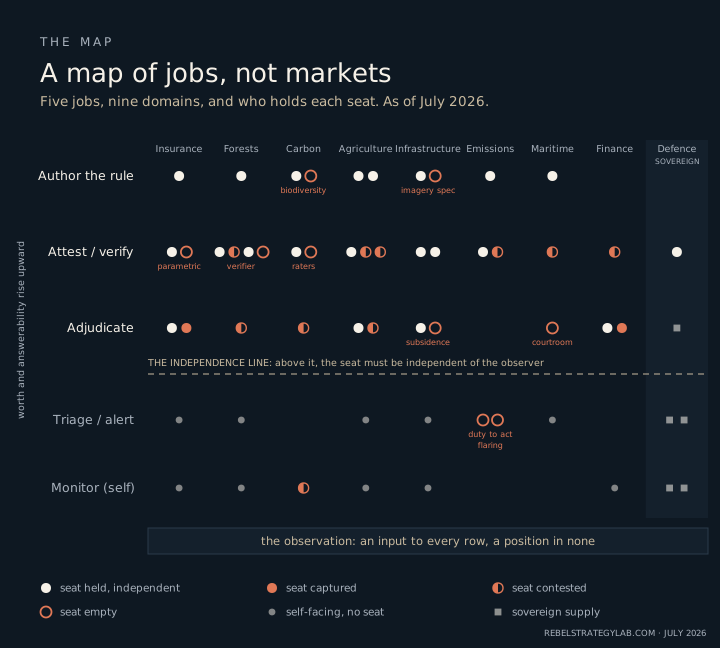
It also gives the industry’s oldest pain an address. Every EO company knows pilot purgatory: the trial that renews and renews and never converts. Pilots die where the job’s reference does not exist, because without a standard nobody can be defensibly accountable using your output, however good it is. No shared definition of a valid parametric trigger. No admissibility rule for satellite evidence in a courtroom. No duty to act on a methane alert. The buyer liked the product; the buyer had no rule to be right under.
Those empty seats read like an opportunity list. They are not. A job is not a market. A job can be real and unfunded: nobody pays for their own enforcement, which is why the duty to act on a methane alert stays unowned while the detection gets better every year. It can be episodic, with alternatives good enough that courts weigh satellite evidence case by case and value their discretion. It can be too diffuse to bill anyone for, the way a biodiversity unit has no agreed measure. Most empty seats are empty because demand never formed there, not because nobody noticed them. Demand forms three ways. A mandate arrives, a loss makes liability real, or an operation reaches the point where it cannot run without the feed: three forcing functions, none of them in a vendor’s gift. Tailings monitoring went from optional to required when a dam collapsed in Brazil, the prosecutions followed, and the standard written in the aftermath named satellite monitoring as a condition of operating. The sensors had been good enough for years. Whether anyone is accountable enough, funded enough, stuck enough to pay to have a job done is a different question, and the map cannot answer it.
What a company that sells observations can win is narrower, and real. You will not own the reference; you can be written into it. The EU deforestation rules name the file format. The common agricultural policy wrote Sentinel monitoring into law. The carbon registry names its approved data providers. Being specified into a reference somebody else owns is the durable version of the position everybody is chasing.
And the map is dated, deliberately. A seat sits empty until a force arrives, and the forces run on different clocks. Mandates move at the speed of politics, which reverses: the deforestation rules have been postponed twice. Liability arrives on the day of the disaster: the tailings standard came a year and a half after the dam failed. Necessity is the slow clock and the surest: where an operation cannot run without the feed, the standard tends to follow, the way aviation ran on weather long before anyone wrote the rules down. Sometimes it happens in private: defence never publishes its standard, so the standard coming does not always mean a public seat. Every empty seat on the map has a date on it.
So the map is a start. It will tell you which of the five jobs your product feeds, whose rule the answer must pass, and which economics you are standing in: the kind that falls to the price of a picture unless operations come to depend on it, or the kind that pays for conformance to a standard you will never own. What it cannot tell you is whether the buyer who owns the job will pay for help with it, or whether your input is the one that gets written in. The job was never yours; it belongs to the person who answers for the number. Knowing which job you are helping with is where the demand question begins, and the map stops there.