
A compliance officer at an oil major has been responsible for the EU Methane Regulation’s facility-level monitoring, reporting and verification requirements since the regulation entered force in 2024. By 2026 they have eight EO vendors who can produce methane data over their facilities: GHGSat at sub-25-metre SWIR with a 100 kg/hour attribution threshold, MethaneSAT at finer spectral resolution, Sentinel-5P at global coverage with a ~7 km footprint, ICEYE methane work via SAR-derived activity proxies, EnMAP for hyperspectral validation, and several smaller players. The mandate requires verified facility-level emissions. The vendors each report something different. No institution defines which vendor’s product satisfies the verification requirement, what cadence is required to count as compliant, what audit trail regulators will accept, or how vendor-specific outputs combine into the single verification number the regulator references. The mandate is one document. The EO products underneath are not the same. At the moment no institution defines which translation is correct.
Operators see the same gap from the other end. Pricing fundamentals do not work for most commercial use cases of high-resolution EO. Minimum purchase areas, per-km² costs that make pilot economics impossible, VHR licensing that prevents the data from being operationalised by anyone except the original buyer. Several constellation operators have attempted reform. Most have drifted out of the commercial-transparency trajectory entirely in the last eighteen months.
The pricing graveyard
When I started looking into the pricing of EO data, there were five operator trajectories in the last three years, and they map the shape of the problem.
Umbra publishes a full SAR rate card (around $675 per scene at 1m, scaling to $5,000 and above at 16cm) and licenses imagery under CC BY 4.0, which it calls the most permissive satellite data licence ever offered. The parallel revenue layer is increasingly defence-coded: a multi-year dedicated-capacity deal with Maxar (now Vantor), the merchant components business announced in August 2025 that sells SAR spacecraft parts to other operators, NRO customer status, and a STRATFI award from the US Air Force in April 2025. The shape is transparent commercial pricing layered with defence-coded enterprise tiers, where meaningful revenue migrates toward relationship terms over time. Umbra has not retreated from its public model. It has supplemented it with an enterprise track that pulls toward defence.
Vantor (the rebranded Maxar Intelligence) sunset its Analysis Ready Data product effective 31 January 2026. Vantor led the commercial EO market by revenue share in 2024 at 21.3%, ahead of Airbus Defence and Space. Planet leads on satellite count and area coverage; Vantor and Airbus lead on revenue and very-high-resolution (VHR) optical. The explicit company statement on the ARD sunset: “maintaining ARD as an Imagery product/format-type no longer aligns with our product strategy.” The replacement products (FlexView, FastView) are tasking products, not standardised intermediate substitutes. Vantor’s revenue is heavily concentrated in defence and intelligence, the buyer that does not need ARD because NGA already translates intelligence requirements into tasking orders. The revenue-share leader in commercial EO walked away from technical standardisation because its dominant buyer never needed it, and the commercial buyers who did need it were not paying enough to keep the product alive. Standardisation gets cut when the defence revenue does not require it.
Satellogic launched Aleph Observer on 23 February 2026, a pivot from per-image transactional sales to subscription monitoring. The 2023 $8/km² rate is still on the website but is no longer the headline commercial offer. Satellogic’s FY2025 10-K shows 90% of revenue coming from Data and Analytics rather than imagery sales. A $12M defence satellite sale in April 2026 sits inside that mix. The reimage-the-whole-earth thesis quietly became a subscription monitoring business with a defence-revenue tail.
Capella never went fully transparent. Console was self-serve and scene-based, but no public dollar amounts were ever published. Archive Subscriptions were added in 2024. In July 2025 Capella was acquired by IonQ for $311M and repositioned for a quantum communications buildout. Capella never entered the commercial transparency trajectory in the first place; the IonQ acquisition removed even the partial engagement it had.
Pixxel sits earliest in the arc. The $8/km² hyperspectral rate remains active, and the Aurora platform launched in August 2024. ARD is committed under the IN-SPACe EO Public-Private Partnership for India’s national EO constellation (12 satellites, ₹1,200 crore over five years), scoped to government procurement under the Indian national programme rather than a general commercial product spec. The ARD commitment is institutional standardisation forming under a different jurisdiction with the same pattern as Copernicus under the EU. Pixxel commercially remains in the early transparency phase, before the layering or pivot or exit has happened.
Five operators, five different trajectories, all moving away from the commodity-pricing equilibrium that pricing reform was supposed to converge toward. Umbra layered enterprise tiers onto a transparent foundation; Vantor sunset standardisation under defence-revenue pull; Satellogic pivoted to subscription monitoring with a defence-revenue tail; Capella exited via the IonQ acquisition into quantum communications. Only Pixxel remains in the original transparency phase, and the segment-specific economics of hyperspectral leave room to wonder how long that holds.
Planet sits outside the pricing-reform trajectory above but shows the same defence-pull pattern at the satellite-count leader. FY2026 revenue reached $307.7M and the company hit its first full-year adjusted EBITDA profit. Defence and Intelligence grew 77% year-over-year. Civil Government grew 14% to $20M. The Commercial segment stayed flat at $14M for the full year, roughly 5% of total revenue at the most commercial-positioned operator in the constellation business. Vantor’s ARD sunset is the defence-pull at the revenue leader; Planet’s $14M commercial floor is the same pull at the satellite-count leader. Both companies point to the same structural mechanism.
The pattern is consistent enough to read as structural, not as an execution failure across five companies. Pricing reform in commercial EO does not stabilise because the model operators are reaching for, SaaS-style consumption with self-serve onboarding and published rates, is borrowed from a layer of economic infrastructure that has not formed in EO and will not form because it’s based on different design principles and assumptions.
Licence as the institutional layer commercial imagery already has
The pricing graveyard is half the story. The other half is the licence, and the licence already does institutional work on the supply side, just badly.
Each commercial EO operator publishes its own EULA (end-user licence agreement). Restrictions on redistribution, sub-licensing, sale to third parties, and use as legal evidence are negotiated customer-by-customer. Umbra’s CC BY 4.0 stands out specifically because it eliminated the licence-friction layer on the supplier side. The result was not commodity pricing forming around Umbra’s imagery. Buyers are not purchasing imagery as a commodity in the first place; they are seeking answers to specific questions. The missing piece on the buyer side is the institutional translation of those questions into the imagery that satisfies them. Transparent price plus permissive licence does not produce commodity pricing when the unit being priced is not what the buyer actually wants.
Licence is institutional standardisation as a supplier-side mechanism, fragmented across each operator’s lawyers. The demand-specification body that has not formed is the institutional standardisation as a buyer-side mechanism. Both sides need it; only the supplier side has anything approaching one today, and it is not unified.
The SaaS scaling assumption
SaaS economics depend on three compounding conditions. The product is non-rival: one customer’s use does not block another’s, so the marginal cost of an additional user is near zero. The workflow is repeatable across customers because there is an underlying workflow abstraction the SaaS layer captures. Salesforce works because every company manages contacts, opportunities, and deals. The SaaS layer captures that shared shape and lets customers configure the specifics on top. Snowflake works because data warehousing generalises across industries. Value lives in ongoing engagement with the software, so switching costs compound. Take any one out and you have software with services attached, which is a viable business (and is what many companies marketing themselves as SaaS actually are), but not SaaS scaling. The SaaS frame, applied to commercial EO, is the illusion.
Commercial EO breaks all three, though the workflow abstraction question is sharper than “workflows are not repeatable.” Imagery is asymmetrically non-rival: archive data can be sold many times, constrained primarily by licence terms, while tasked imagery is rival in the moment of tasking. The non-rivalry is institutional rather than technical. Value is point-in-time delivery for a specific decision, not compounding through ongoing engagement.
The workflow point needs unpacking. The buyer’s process workflow is often abstractable in the way SaaS requires. Every insurer does flood underwriting in roughly the same shape, every oil major does facility-level emissions reporting in roughly the same shape, every consumer-goods company does EUDR due diligence in roughly the same shape. Guidewire abstracts insurance underwriting at the process layer and serves hundreds of insurers. The gap is one layer above. The EO input that feeds those workflows has not been institutionally standardised. No agreed-upon satellite product spec says “this is what counts as compliant facility-level methane attribution” or “this is the flood-exposure dataset Solvency II references.” Each EO vendor produces something different, and each buyer has to integrate vendor-specific output into their already-abstracted process workflow. The SaaS layer fails not because the workflow is unabstractable, but because the EO input has no shared specification.
This is the cause behind the data-versus-infrastructure split I named in Earth Observation Sells Data. Markets Buy Infrastructure. EO sells data because the spec the buyer’s workflow can consume as commodity input does not exist. Markets buy infrastructure because that spec, where it exists in adjacent markets, lets the same data flow through abstracted workflows at SaaS scale. Until the institutional layer produces an EO product specification the buyer’s already-abstracted workflow can consume, EO stays on the data side of that binary.
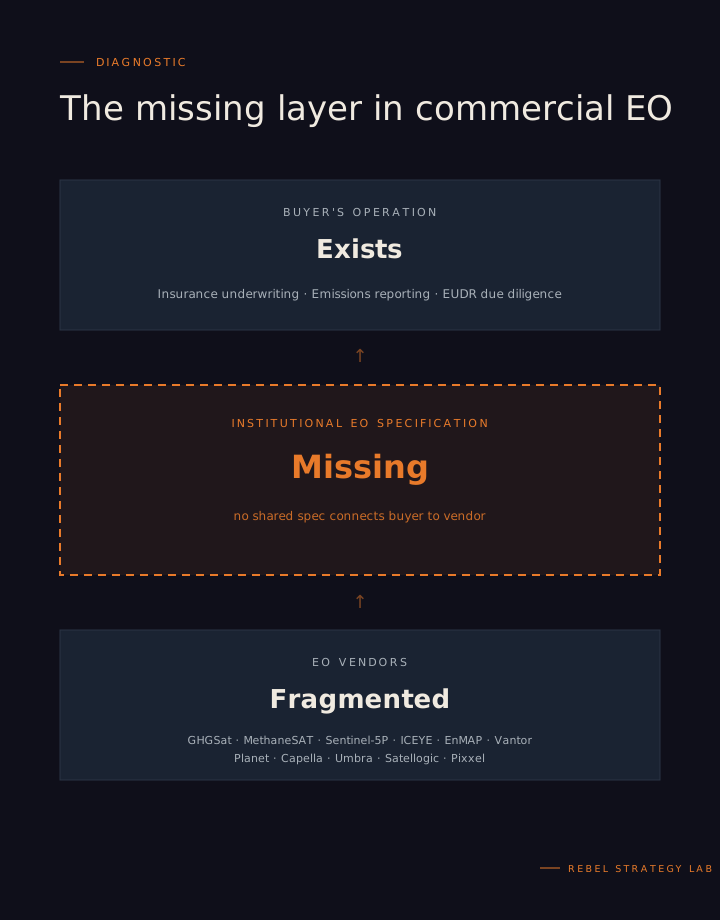
Both questions presuppose that institutional recognition and supply-side standardisation can hold for a given segment. They can’t always. Where the buyer’s operation cannot accept external EO data as a legitimate input (strategic intelligence interpretation where the value lives in human context-specific judgement, frontier research where each question is bespoke), institutional recognition isn’t a gap to close. The fit doesn’t exist. Where the supplier output is irreducibly use-case-specific (custom multi-sensor fusion designed per research question), standardisation isn’t a gap to close either, because the spec doesn’t generalise across cases. For mandate-driven commercial EO compliance, the assumption holds: the operations (insurance underwriting, emissions reporting, sustainability disclosure) have absorbed external data inputs from adjacent markets via institutional standardisation for decades, and the EO specs mandate compliance would need are physical and process descriptions that generalise across compliant cases. The layer can form. It hasn’t.
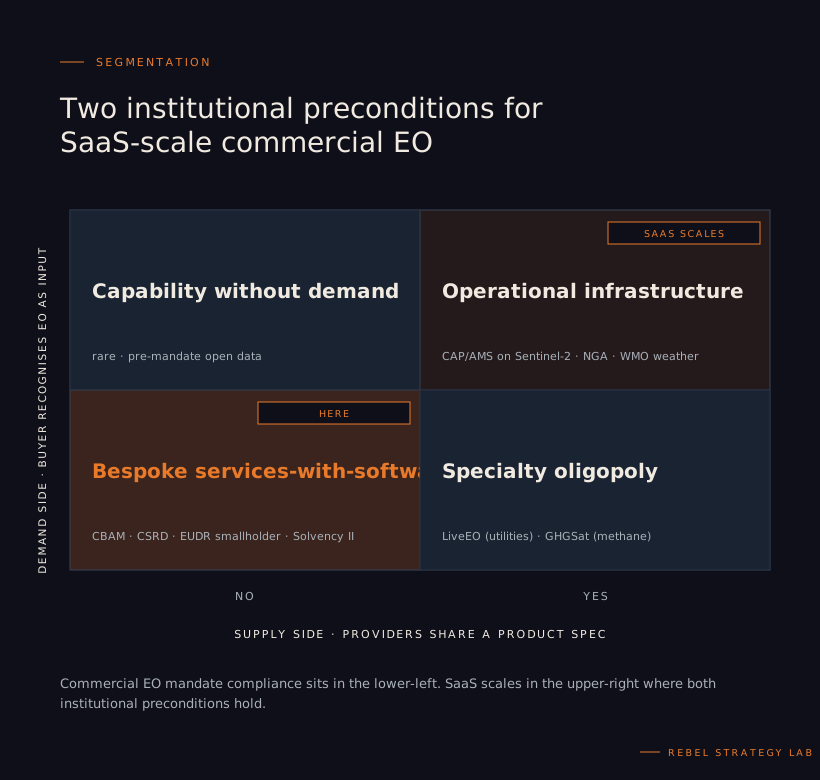
Both layers can hold at the same time, and where they do, EO at SaaS scale works. Climate FieldView reached around 250 million subscribed acres because farm management is a naturally repeatable workflow at the individual farm cycle (plant, treat, harvest, assess yield), and because the EO input layer underneath relies on Sentinel-2 as a free public baseline that the analytics layer treats as commodity input. CAP (Common Agricultural Policy) and AMS (Area Monitoring System) compliance monitoring works on Sentinel-2 because the EU institutionalised both layers: the question (compliance monitoring) and the input dataset (Sentinel-2 as the reference). Both abstractable, both standardised, both in place. The exception that proves the rule.
Where the EO input is not institutionally standardised, the SaaS abstraction breaks at the analytics layer too. Jupiter Intelligence positions as a SaaS climate-risk platform, but every enterprise deployment carries a material consulting and onboarding overlay. Each customer needs the flood-risk parameters tuned for their portfolio geography, asset class, reporting cadence, and, more importantly, their interpretation of what compliant means under a mandate that has not been translated into an EO spec. The product is partially SaaS, partially solutions delivery. The last public funding round was Series C in September 2021, and the platform has not produced the kind of viral growth pure SaaS economics would. The analytics layer hides the input-standardisation problem for longer. It does not solve it.
I saw this from the inside at ICEYE. We had teams whose job was to do the pilot integration the product could not do as a product. Each new customer was a custom build dressed up in a recurring contract. The cognitive-empathy work to understand the buyer’s actual decision workflow was being done by a sales-adjacent team after the product shipped, rather than being engineered into the product from the start. The product looked like an enterprise SaaS deal, and the unit economics looked like consulting.
Project versus product thinking
There is a huge difference between project thinking and product thinking. Project thinking asks “when,” optimises for outputs, scales execution multiplicatively. Product thinking asks “why,” optimises for outcomes, creates the what-works exponentially. Most commercial EO companies are stuck in project mode by structural necessity, not preference. The institutional layer that would standardise the buyer’s workflow has not formed, so every deployment carries enough customisation to force project mode.
A dedicated team doing pilot integration is project mode incarnate. Jupiter’s per-customer flood model builds are project mode. The pattern persists because the operator-side capability to escape it is missing too.
Most commercial EO constellation operators built deep supply-side domain knowledge (sensors, orbits, calibration, processing chains) and limited demand-side fluency. Demand-side fluency is not industry knowledge. Hiring a sales director from the utility sector closes the industry-knowledge gap; it does not generate understanding of what the buyer is actually trying to decide, against what mandate, with what data, by when. The compliance officer at the oil major in the opening is not waiting for a salesperson who can speak energy. They are waiting for a product that satisfies a verification requirement they cannot fully articulate. The operator who builds a sales motion without demand-side fluency closes deals; it does not produce the structural solution to the buyer’s job. The product team still cannot tell the buyer what verification cadence the regulator will accept, and the sales director’s relationships do not generate that specification.
The operational buyer commercial EO does not reach is the same buyer demand-side fluency would let operators see. The exception that proves the rule is defence: operators reach defence buyers with less friction than commercial buyers, less because they understand the analyst’s decision workflow in depth and more because the institutional layer (procurement language, spec format, delivery channels) made the buyer’s questions legible without operators needing to learn them from scratch.
The defence-pull is the through-line of the five pricing trajectories above. Vantor sunset standardisation because defence does not need it. Satellogic pivoted to a subscription model with a defence revenue tail. Capella exited to a defence-quantum acquisition. Umbra’s enterprise tier is increasingly defence-coded. Planet’s commercial segment is flat at $14M while defence and intelligence grew 77%. Vantor’s April 2026 Vantage and Pulse constellation announcement committed the revenue leader to a defence-first architecture through approximately 2032. The pattern across the five operators, plus Planet, plus the next-cycle architecture is consistent: commercial EO is effectively a defence-dependent market with commercial cosmetics (it is good for VC funding and marketing). The defence layer has institutional translation; the commercial layer does not. Operators rationally invest in the buyer whose institutional context lets unit economics close.
What weather and defence did differently
Numerical weather prediction solved the technical-standardisation problem over decades. The World Meteorological Organisation (founded 1873 as IMO, became WMO under the UN in 1950) standardised the GRIB format in 1985 and the BUFR format in 1988. Every downstream application, from aviation routing to energy demand forecasting to parametric crop insurance to the weather app on a phone, builds on the same intermediate layer. Roughly 110 years between IMO founding and GRIB ratification.
Defence solved the institutional translation problem through consolidation. NIMA (founded 1996, renamed NGA in 2003) absorbed the Defense Mapping Agency, the National Photographic Interpretation Center, the Central Imagery Office, and imagery elements of the CIA, DIA, and NRO. Intelligence consumers articulate needs; NIMA-then-NGA translates into tasking orders with specific sensor, resolution, cadence, and delivery channel. The buyer does not have to think about pixels. Thirty years of institutional infrastructure between the question and the imagery.
Commercial mandate-driven procurement in EO has not yet formed either layer. The mandates themselves are five to fifteen years old at most. The EU Methane Regulation entered into force in 2024. CBAM enters the definitive period in 2026. CSRD verification requirements are forming through implementing acts in 2025-2026. The EU climate resilience framework moves through comitology toward adoption in late 2026. Buyer demand is forming faster than the institutional translation has historically formed in any analogous market.
What the missing layer would look like
The translation desk has not yet formed in commercial EO. There are historical analogues in adjacent markets that describe what its shape could look like.
In defence, NIMA-then-NGA is a government agency because the buyer was the state. In weather, WMO is multilateral because weather data crosses borders by physics. In finance, the Bloomberg Terminal became a de facto standards body without being designed as one, because the market for standardised financial data formed faster than any regulator could move; formal accreditation followed market adoption by decades. In ESG ratings, MSCI, Sustainalytics, and ISS captured the layer because regulators referenced existing commercial ratings rather than building their own; the EU ESG Ratings Regulation now enforces ESMA supervision over them, twenty-nine years after the Kyoto Protocol that created the original demand pull.
Two patterns of formation appear across these cases. The Monks pattern (textbook embedded entrepreneur): Robert Monks wrote ERISA’s fiduciary-voting rule at the US Department of Labor in 1984, then founded ISS in 1985 to supply compliance with the rule he authored. Buyer-side fluency, commercial business and institutional work in parallel. The adoption pattern (the rest): commercial businesses built legible artefacts that made an opaque unit of measurement legible enough for regulators to reference later. Bloomberg’s identifier codes became market standard before formal accreditation followed. The Domini 400 Social Index served as the benchmark before MSCI acquired KLD. Sustainalytics’ ratings became market-referenced before Morningstar acquired it and before the EU regulated the sector.
The agent of formation is rarely the embedded entrepreneur. More often, it is the founder who makes a sector-specific unit of measurement legible to a defined buyer pool, with regulators referencing the artefact after it has reached operational adoption. For commercial EO, this means the formation agent is the founder who makes facility-level methane attribution, asset-level flood exposure, or sub-5-metre smallholder forest cover legible to a specific set of regulated buyers. The founder whose product becomes the spec by adoption.
The shape varies by who needs the layer and who can credibly build it. For commercial EO mandate compliance, the shape most likely fits a hybrid. Regulators (the European Commission, ESMA, EBA, EIOPA, the bodies that own each mandate) issue compliance obligations and have legal authority. They have not built internal capacity to translate obligations into satellite specifications. Industry consortia (CEOS, OGC, the Group on EOs) have technical depth but lack regulatory authority. Hyperscalers with planetary-scale platforms (Google Earth Engine, AWS Open Data, Microsoft Planetary Computer) have implementation capacity without a mandate-translation role. The body that captures the formation is whichever combines all three, or a private founder whose product becomes the de facto reference before any of them combine.
The closest existing institution to this shape is the European Commission’s Joint Research Centre, which does meaningful EO translation work upstream of mandate-owning DGs: scientific input into mandate design, technical support to policy teams, and reference implementations like the deforestation classification benchmarks underpinning EUDR. The gap still sits one institutional position downstream of JRC, in a specification-issuing body embedded in the procurement layer of the mandate-owning DG rather than the scientific-input layer upstream of it.
The shape of the gap is most visible where the mandate is binding and the EO methodology is absent. CBAM enters its definitive period in 2026 with a verification methodology that is documentary and site visits, with no EO requirement, no satellite specification, and no remote-sensing data product referenced in the implementing acts as of May 2026. Simply because nobody has translated the verification problem into a satellite specification. The absence of EO in CBAM is the institutional translation gap, made visible at the largest single climate-mandate procurement opportunity of the decade.
The same shape appears at finer resolution in the EU Methane Regulation, which entered force in 2024 with monitoring, reporting, and verification requirements that the regulation itself does not specify in EO terms. GHGSat covers the segment above the 100 kg/hour threshold via SWIR. MethaneSAT, Sentinel-5P, ICEYE methane work, and several smaller suppliers each produce different products. The regulation requires verification. No institution defines which product, at what cadence, with what attribution methodology, counts.
In day-to-day terms, the missing body would issue artefacts like a facility-level methane verification specification (v1.0) defining: which sensors qualify at which thresholds, what derived products count as compliant, what attribution methodology is required, what uncertainty bounds the product carries, what ground truth the verification rests on, what audit-trail format regulators will accept, and what the revalidation cadence is when underlying conditions change. Suppliers build to the specification. Buyers procure against it. Independent verification firms certify supplier outputs against it.
The chain from specification to integration to commodity pricing is not automatic. Defence has a specification (NGA) without commodity pricing. Defence procurement is a relationship-priced single-buyer speciality oligopoly. Weather has both specification (WMO/GRIB) and commodity-priced multi-provider integration. The difference is the buyer pool: defence has one dominant buyer with strategic sensitivity that resists commoditisation; weather has a fragmented buyer pool with no individual buyer powerful enough to capture the supplier base. Commercial EO mandate compliance more closely resembles weather: many regulated buyers across sectors, no individual buyer with strategic sensitivity. The chain has a better chance of running in this market than in defence, if the specification gets written.
This argument is in the optimisation register: form the spec so EO data feeds existing operations at SaaS scale. The optimisation lens has a structural limit. It assumes the existing operation is the right unit. Where it isn’t, the institutional layer’s job is creation, not translation. The candidates: parametric insurance replacing indemnity claims processing, continuous compliance monitoring replacing periodic audit, asset-level real-time risk replacing portfolio aggregates. That is the subject of the next piece in this series.
Why has it not formed yet
So why have ten years of commercial EO not already produced this layer, given that the mandates exist and the demand pressure is real?
There are five structural obstacles and a lack of incentives to actually do so.
Regulators write the mandates without embedding satellite data product specifications in the procurement layer. The European Commission ships CBAM as a carbon accounting framework. ESMA writes ESG ratings supervision as a financial services regulation. The EU Climate Resilience framework moves as an adaptation policy. The Joint Research Centre provides scientific input upstream of these mandates and does meaningful EO work, but it operates one institutional position removed from procurement. None of the mandate-owning DGs has a publicly visible team whose job is satellite-data product specification at the procurement layer. They issue the mandate and assume the market will produce the products.
No existing body publicly combines all three required capabilities. Regulators have legal authority and limited technical depth. CEOS and OGC have technical depth but lack implementation capacity or a regulatory mandate. Hyperscalers have implementation capacity but lack the institutional position to issue specifications. The federation that would combine them has not been built.
The vendors closest to the problem have the least incentive to standardise. Constellation operators benefit from licence fragmentation because relationship-priced enterprise deals are more profitable than commodity pricing. Defence-heavy operators have a stronger version of the same disincentive: their dominant buyer does not need the commercial standardisation layer at all, so investing in it competes for engineering resources against products the actual buyer is paying for. The Vantor ARD sunset is the most recent named case. Analytics companies benefit from custom integration because each bespoke build is consulting revenue. The vendors with the most domain knowledge to write a specification are the ones financially aligned against writing it.
The mandates themselves are too new. EU Methane Regulation 2024. CBAM definitive period 2026. CSRD verification began in 2025. The EU climate resilience framework is set for adoption in late 2026. Historical institutional layers have formed operational specifications in five to fifteen years after the demand-creating mandate, with full regulator-supervised status taking seventeen to thirty years. EO is roughly one to two mandate cycles too early to expect full formation.
The buyer’s side does not know what to ask for. Compliance officers do not know what a satellite specification would look like. They cannot demand a translation desk because they cannot articulate the shape of what they need. Asymmetric information makes the buyer-side demand for the institutional layer almost invisible until someone starts producing it, and buyers recognise what they were missing.
These obstacles are independently solvable and collectively structural. The formation will not happen because someone decides to start. It will happen because regulatory bodies, industry consortia, hyperscalers, and a few willing analytics-layer founders begin to converge on the same specification language under enough demand pressure that the alternative becomes more expensive than the coordination cost.
That convergence is already starting. The vocabulary from which the eventual institutional layer will be built is being chosen over the next 12 to 24 months, even though full formation is 5 to 15 years out. The CBAM third-country carbon-price deduction implementing act is subject to a 4-week consultation from 13 May to 10 June 2026, retroactive to imports from 1 January 2026. Vantor’s Vantage and Pulse constellation announcement in April 2026 commits the revenue leader to a defence-first architecture through approximately 2032. The Copernicus Data Space Ecosystem Sentinel L3 mosaics released in March 2026 establish what an analysis-ready intermediate product looks like under EU remit. Whoever shapes the vocabulary now shapes what gets built later.
Where the layer is partially forming
The institutional layer is not absent everywhere. It is forming partially, in several places, at scales that do not yet commoditise costs across providers.
Regulatory specifications. EUDR Implementing Regulation 2024/3084 specifies submission formats (GeoJSON, six-decimal coordinate precision, 25MB file caps), the closest existing case of an EU implementing act naming EO standards in text. The Pipeline and Hazardous Materials Safety Administration issued a Direct Final Rule in July 2025 (effective 9 October 2025) that legitimised satellite imagery for pipeline right-of-way patrol without setting a technical specification for it. INGAA, the industry association for natural gas pipeline operators, supported the rule. Both cases are partial: EUDR specifies the submission format but not the EO product itself; PHMSA legitimises the inspection method but leaves the technical specification undefined.
Supervisor-side capacity. EIOPA partnered with EUSPA on a March 2026 joint white paper on Sentinel-1 flood data for Solvency II supervision and operates a Catastrophe Data Hub. ESMA and EBA do not yet have an equivalent. The EIOPA-EUSPA mechanism is the institutional-formation move: a financial supervisor building EO capacity through partnership with the EU space agency rather than through internal hire.
Upstream technical standardisation. Copernicus Data Space Ecosystem released seamless monthly Sentinel-1 and quarterly Sentinel-2 Level 3 mosaics covering the full archive from 2014, announced in March 2026. Pixxel’s IN-SPACe EO Public-Private Partnership commits ARD across panchromatic, multispectral, hyperspectral, and SAR sensors over five years for India’s national constellation. OGC STAC was adopted as the discovery standard by Copernicus Data Space in February 2025. The intermediate-product layer is forming where institutional remit exists (Copernicus under the EU, IN-SPACe under India), though it has not yet bridged into mandate translation.
Industry-side standards. Swiss Re operates standardised indices (NDVI, soil moisture, water height) across its parametric book. Aon-Floodbase-Swiss Re launched a parametric storm-surge product in February 2025. Floodbase released a Quote API in March 2026 that standardises U.S. flood quoting at the workflow level. Bloomberg’s identifier codes were market standard for decades before formal accreditation arrived in 2024. Industry-side standardisation precedes regulator-side specification in most adjacent markets, and is now doing so in EO.
Five separate formations across regulators, supervisors, upstream technical bodies, and industry. None is yet a commercial mandate-translation desk. All of them are vocabulary being chosen.
What strategy and capital are underwriting
Commercial EO today is being underwritten on two assumptions at once, by operators raising capital and funds deploying it.
Firstly, it is application-layer companies that bear the integration cost that the institutional layer would absorb if it were formed. A substantial share of each company’s capital and engineering goes into building its own version of the multi-source data stack, customer-by-customer specification translation, and per-deployment audit infrastructure. The aggregate spend across the several dozen commercial EO analytics companies is meaningful, parallel, and largely uncoordinated. Each company carries the structural overhead alone.
Secondly, it is underwriting against a formation timeline that has three distinct thresholds, not one. Operational utility (the layer producing useful market function) forms in roughly 5 to 10 years from the mandate-creates-demand-pressure. Bloomberg was usable infrastructure for traders by 1986, year 5. Sustainalytics and PRI were commercially relevant by year 5 to 8. CRSP was usable by the early 1970s, year 10 to 13. Exit-defensible scale (the layer supporting valuations and exits) forms in roughly 8 to 10 years. Full regulator-supervised status (the layer becoming the binding compliance reference) takes 17 to 30 years. The EU ESG Ratings Regulation imposed ESMA supervision on the ESG ratings sector from 2 July 2026, 29 years after Kyoto.
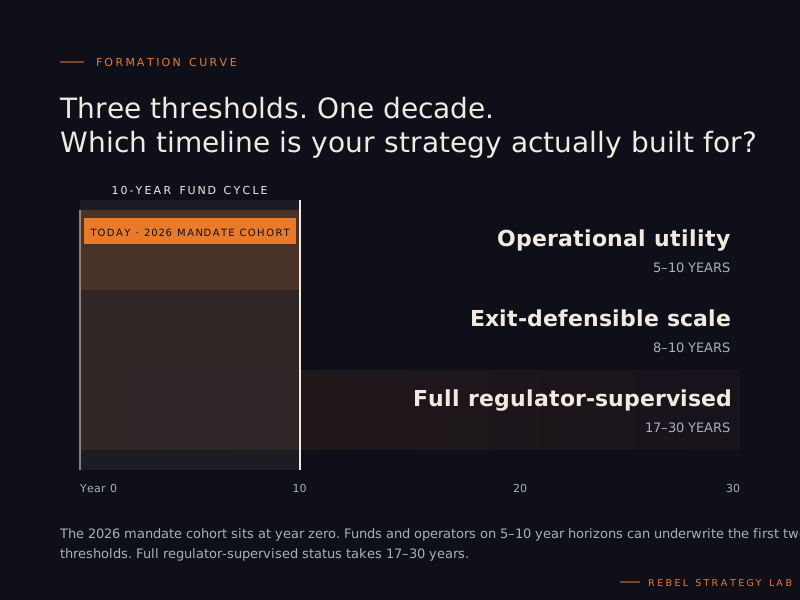
Both operators and funds in commercial EO are timing 5-10 year strategic horizons. Operators between rounds and to exit; funds between deployment and exit. Both face the same structural choice: bet on operational-utility-and-exit-defensible-scale formation, or wait for full regulator-supervised status. The first two thresholds are inside both binding constraints. The third is outside both. The strategic stake sharpens: which threshold is your strategy actually riding? An operator or fund underwriting on the assumption that the institutional layer will form to commoditise integration costs needs to be on the first or second threshold. The 17–30 year band is the terminal frame. The 5–10 year band is the binding reality for everyone underwriting it.
Some companies will succeed by occupying segments where the workflow is naturally standardised (agriculture, weather, defence). Some will succeed as the vertical-integration play that becomes a missing layer in microcosm for one segment. Most will fund parallel reconstructions of a layer that does not form fast enough to commoditise their cost structures.
Two equilibria revisited
Commercial EO splits into horizontal infrastructure (where Sentinel-2 baseline plus mandate-translation works) and vertical integration into a speciality oligopoly (where a single provider captures a segment). The industry has sharpened this thesis through 2026.
The horizontal infrastructure case forms where the workflow is institutionally standardised. CAP and AMS agricultural monitoring works because the EU institutionalised the question, and Sentinel-2 clears the cost gate. Farm management at the individual-farm scale works because the workflow is naturally repeatable. Parametric crop insurance attaches to both. The pattern is multi-provider, standardised target, value stacking rather than competing. Copernicus Data Space Ecosystem extended what the baseline supports in March 2026 by releasing seamless monthly Sentinel-1 and quarterly Sentinel-2 Level 3 mosaics covering the full archive from 2014, moving Sentinel from raw collection to analysis-ready intermediate product. The intermediate-product layer is forming, where Copernicus has the remit. Mandate-compliance specifications stay unformed because nobody has the equivalent remit.
The Sentinel-2 baseline counter-position to this piece — that the SaaS-analytics-on-Sentinel-2 model already covers most mandate compliance — is locally true and globally narrow. Large-monoculture EUDR runs on JRC’s 10-metre Global Forest Cover map. CBAM’s verification methodology, per the November 2025 draft, is documentary and site visits with no EO requirement. CSRD/ESRS specifies no satellite resolution. Where the Sentinel-2 baseline plus Copernicus intermediates covers the mandate, the horizontal-infrastructure case has formed. The territory where it breaks is specific: smallholder agroforestry under EUDR (sub-5-metre, where JRC accuracy drops to roughly 76%), facility-level methane attribution under the EU Methane Regulation, asset-level financial-risk underwriting under Solvency II. These are exactly the segments where the binding mandate has not been translated into a satellite specification.
The vertical-integration case is more revealing than the earlier framing showed. LiveEO is the cleanest example in the utilities sector. Their published case studies (E.DIS, Westerville, Liberty) show sub-metre VHR vegetation and encroachment monitoring shipped to grid operators. The case studies describe deployments tailored to each customer; no productised, across-utilities specification has been disclosed publicly. LiveEO is doing the demand specification, the technical pipeline, and the licensing in-house for each utility customer. The vertical-integration model is the missing layer in the microcosm. Each company that captures a segment is building, alone, what an institutional layer would have built for everyone.
GHGSat occupies the same shape in facility-level methane attribution: SWIR-band imaging at around 25-metre resolution, 100 kg/hour facility-level threshold, 60-70% oil and gas customer concentration, EPA and ECCC partnerships, the Spectra subscription platform. One provider has captured the segment because no horizontal multi-provider infrastructure has formed to compete with the integrated stack they built.
LiveEO and GHGSat above are the first of three vertical-integration shapes visible in 2026: supplier-side segment capture, where one provider becomes dominant in a segment without horizontal competition. The second is supplier-side absorption by an adjacent domain-data buyer. Kayrros, the EO-based commodity analytics company ($20.2M revenue, 80 customers), was acquired by Energy Aspects on 13 March 2026. Energy Aspects is a commodity research firm with the buyer-side fluency Kayrros built EO analytics for. Instead of the EO vertical-integration play growing into horizontal infrastructure, it folds upward into the buyer’s data stack.
The third shape is buyer-side vertical integration upstream. Aravind Ravichandran of TerraWatch Space reported in May 2026 that at least six major global energy and utility firms had briefly or seriously considered launching their own EO satellites in a single month, triggered by restricted access to commercial high-resolution imagery over the Middle East and the recognition that imagery is strategically critical to their operations. The observation is single-source and qualitative; the structural read is that when neither institutional translation nor supplier reliability can be assumed, the buyer stops waiting for the layer to form and considers going upstream of the entire problem. If the conversations Ravichandran describes are happening at the rate he reports, that is the buyer-side acknowledgement that the institutional layer is structurally missing.
Each shape produces a different lock-in (single-provider, single-buyer, single-asset-owner) and none produces multi-provider commodity pricing. The counter-position that vertical integration at the segment level is durable enough to substitute for horizontal infrastructure has a partial answer here. Every outcome locks the segment to single-party economics. The vertical-integration response is the substitute for the missing layer, not the alternative to it.
What would mark transition?
The partial formations above stop being partial when they meet specific transition thresholds. Five worth tracking over the next 18 months.
EU implementing acts naming EO product specifications, not only submission formats. EUDR 2024/3084 named the submission format; the next mandate or the next iteration of EUDR naming the underlying EO product spec is the transition signal. The CBAM third-country implementing act, in a 4-week consultation closing 10 June 2026, is the immediate opportunity for EO methodology to enter CBAM’s verification language.
ESMA, EBA, or EIOPA building internal EO capacity beyond partnership with EUSPA. EIOPA’s joint white paper is the partnership move; an in-house EO function at the supervisory specification layer is the transition signal.
CEOS, OGC, or ISO EO specifications are being adopted directly as regulatory language. STAC adoption by Copernicus is platform infrastructure; a regulator citing OGC or ISO standards as the binding spec is the transition signal.
Industry body cross-provider trigger standardisation. Swiss Re’s internal indices are vendor-internal; an industry body (IAIS, the Geneva Association, the International Insurance Standards Board) standardising satellite-data triggers across providers is the transition signal.
A founder whose product becomes the de facto specification by adoption. The legibility-artefact pattern: a commercial EO product reaches operational adoption across a defined regulated-buyer set in a specific segment (facility-level methane, asset-level flood, sub-5-metre smallholder forest cover), and regulators reference the product rather than building their own spec.
When two of these transitions land within the same 18-month window, the institutional layer has begun to form. The signal value of any one alone is weak; convergence is what counts.
What then?
Commercial EO has a pricing problem. Reform at the pricing layer cannot solve it because the missing thing is one layer underneath, and it is not technical. It is the institutional translation desk between mandate-driven demand and supplier-readable specifications, paired with the technical standardisation layer that lets multi-provider data integrate against a shared target.
Commercial EO is a defence-dependent market with commercial cosmetics. The defence layer has institutional translation. The commercial layer does not. The five pricing trajectories above are five different routes to the same conclusion: operators select toward the buyer whose institutional context lets unit economics close.
For an operator reading this, the diagnosis surfaces structural questions you are already answering by default. Your runway and cap-table horizon set which threshold your business is implicitly underwriting against. Your segment determines whether the workflow is institutionally standardised or whether you are trying to manufacture that standardisation alone, deployment by deployment. Your unit economics either rest on the SaaS illusion, recurring revenue dressed up as product when the overhead is still project work, or they do not. Where your structural cost lives today determines what an institutional layer would absorb if it formed. The answers describe what bet you are running and how long it has to pay off.
The vocabulary from which the commercial layer will eventually be built is being chosen now. The window is 12 to 24 months. Full formation is 5 to 15 years out. The reader who waits until full formation has missed the window in which the vocabulary was contestable.
Pricing reform was never the constraint. The constraint is who gets to write the vocabulary for the layer that’s about to form.