A carbon credit is what you buy in order to keep emitting.
You burn the fuel. A tonne of carbon dioxide goes up, and it is real: it is in the air, trapping heat, and it will keep doing it for a very long time. Then you buy a credit, one tonne, that certifies a tonne was kept out of the sky somewhere else: a forest left standing, or a village cooking on cleaner stoves. You set the two against each other and your balance sheet reads zero. You have not stopped emitting. You have bought the right to call it even.
The trade only works if the two tonnes are equal. They are not, for reasons that are part physics and part bookkeeping.
The tonne you emitted is an addition to the world’s carbon. It came out of the ground as coal or oil or gas, carbon the living world pulled from the air and buried over tens of millions of years, and burning it put that ancient carbon back into circulation in an afternoon. The tonne you bought to cancel it is almost never a removal. Most of what the market sells is avoidance: a claim that somewhere, someone emitted less than they otherwise would have. When that claim is true, it can keep a real tonne out of the air. But most of the time it is not true: the reduction would have happened anyway, so nothing was prevented. And where the avoided carbon is biological, held in a forest rather than left in the ground, it is only on loan, free to burn or rot back into the sky while the fossil tonne you emitted stays up for centuries. A removal takes a tonne back out and keeps it out. It is the only move that cleanly answers a fossil emission, and it is the rarest thing on the market.
This matters now because the carbon market is in the middle of cleaning itself up, and the cleanup is aimed at the wrong thing. After two years of investigations and falling confidence, the institutions that run offsetting are writing stricter rules, tighter methods, better audits. They are making the certificate more trustworthy. None of it changes what the certificate is: a claim, measured against a hypothetical, that the atmosphere never sees. The market keeps its books, and books can be made to balance. The atmosphere keeps its own, and it registers only what is physically there.
So the question under every credit is simple to ask and hard to answer: is the tonne you bought real, and will it stay? The market has spent thirty years answering no, in five different ways.
The belief that you can trade your way out of a physical problem did not come from nowhere. It came from a success. In 1990 the United States set out to stop acid rain by capping the sulphur dioxide pouring from its power plants and letting them trade whatever was left under the cap. It worked, and not modestly: emissions fell by close to ninety per cent, faster and more cheaply than almost anyone had predicted. For a generation of economists it became the proof that markets can solve pollution, and they set about exporting it. When the world wrote the Kyoto Protocol in 1997, the machinery of carbon trading went in with American fingerprints on it.
But look at what made the sulphur programme work, because it is exactly what carbon offsetting left behind. Sulphur came from a few hundred power plants you could point at, in one country, under a hard cap, measured at the smokestack, enforced by a regulator who could shut you down. Every one of those conditions is missing from offsetting. Carbon comes from everywhere, across nearly two hundred countries, under no cap at all. And it is not measured at a smokestack. It is measured against a guess about what would have happened otherwise. A capped market like Europe’s emissions trading system kept the ceiling the sulphur programme relied on; offsetting kept the trading and threw the cap away. What follows is about offsetting, the credit-by-credit kind, not the capped markets that price carbon outright.
There was supposed to be a brake. The Protocol said offsets should be supplemental to actually cutting your own emissions, a last resort rather than a substitute. But it never put a number on the word and never enforced it. The brake was a sentence, not a mechanism. From the first day a company could buy its way to a target instead of changing anything, and the rules allowed it. The market that grew up had no ceiling on how much carbon could be emitted, as long as someone, somewhere, filed the paperwork claiming an equal amount had been avoided.
The whole structure rests on the swap, and the swap rests on the bought tonne being equal to the emitted one. Pull on that and it comes apart in your hand, one assumption at a time.
The first thing the market asks you to believe is that a tonne is a tonne: that a credit from a cookstove project in Kenya is interchangeable with one from a refrigerant plant in China, units you can add and subtract at will. When researchers went through the projects one by one, asking whether the credits matched real reductions, the answer was brutal. Across 2,346 projects and close to a billion tonnes of credits, fewer than one in six held up. The rate ran from around one in ten for cookstoves to two in three for some industrial-gas projects. The accounting counts all of them as the same tonne.
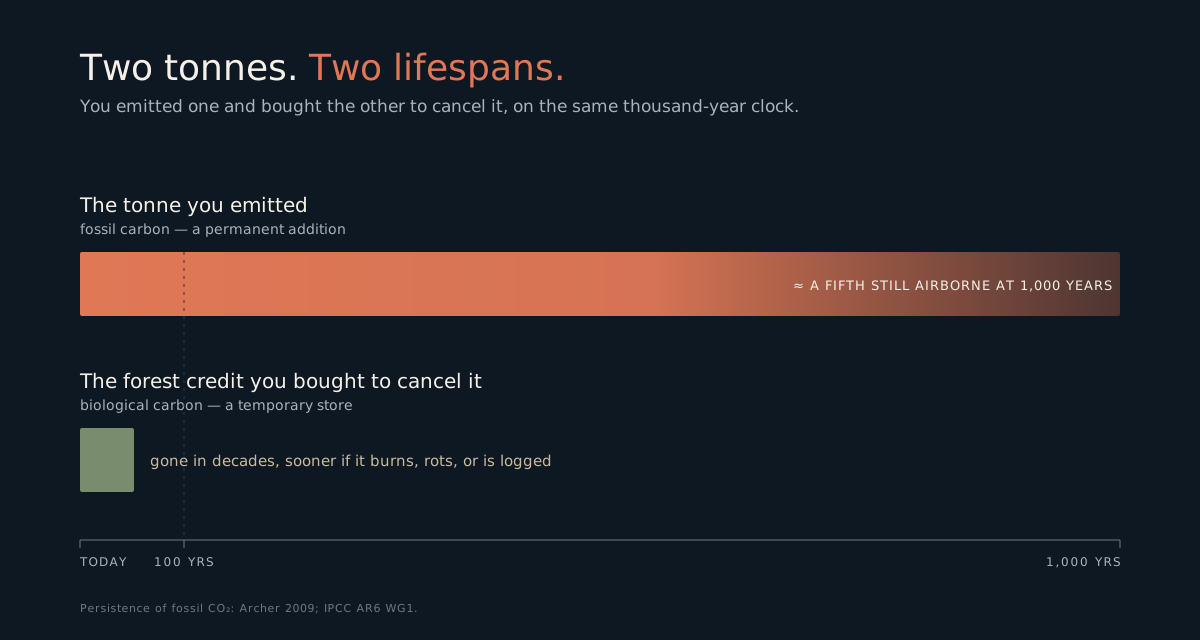
And even the credits that are real collide with the physics. This is clearest with the fossil tonnes that make up most of the problem. Carbon dug out of the ground and burned is, for human purposes, a permanent addition: a fifth of it is still in the air a thousand years later. A forest credit sold to cancel it is not permanent at all. Forest carbon sits in the fast lane of the cycle, on loan, and can burn, rot, or be logged back into the sky within your lifetime. Offsetting a permanent emission with a temporary store trades the two as if they were the same. Some credits do better on this score: destroying a potent industrial gas, for instance, takes a warming agent out for good. But those are the minority. Almost none of the market is the durable kind that could match a fossil emission: around three per cent. The other ninety-seven is mostly the loan.
The second thing the market asks is harder. For an avoided tonne to count, you have to know it would otherwise have been emitted: that the forest really was going to be cleared, that the wind farm would not have been built without the money. This is a claim about a road not taken, and roads not taken cannot be measured, only argued. The European Commission’s own review of the UN offset programme found that 85 per cent of the projects it studied probably were not additional at all. The reductions would have happened anyway, and the credits paid for nothing.
This is where the swap stops being merely empty and starts running backwards. Economists tracked more than a thousand Indian wind farms through the system and found that at least half would have been built without a cent of offset finance. When those credits were sold to factories and utilities that used them to justify emitting more, the result was not a wash. It was extra carbon: a real addition on the buyer’s side, paid for with an avoidance that was never real on the seller’s. Extended across the programme, the authors estimate it may have put six billion tonnes of carbon dioxide into the air, the precise opposite of the thing it was sold to do.
The market knows about the burning and the rotting, and it has an answer: a buffer pool, a shared reserve of spare credits set aside to cover the losses when a forest does go up in smoke. It is insurance. California built one for its forest offsets and sized it to last a century. Wildfire burned through nearly the entire share reserved for fire risk in about a decade. The insurance was priced for a climate that has already stopped existing, against the very risk the credits were meant to help reduce. The reserve that was supposed to make a temporary tonne behave like a permanent one is being emptied by the warming the system exists to prevent.
Behind all of it stands the auditor, the independent check meant to catch the bad projects before the credits sell. Except the auditor is hired and paid by the developer whose work is being judged. A review of the largest registry found that 64 per cent of its auditors had signed off on projects later flagged as problematic. We have seen this arrangement before. It is how the rating agencies came to stamp the highest grades on mortgage securities in the years before 2008, paid by the banks whose products they were rating, producing the verdict the payer wanted. The same structure produces the same rot, for the same reason.
Four assumptions, four failures, and none of it is bad luck. It is what happens when you build a market on a unit that physics does not recognise. The harder question is why the market keeps producing the worst of the swaps rather than the best.
A market is supposed to be good at one thing: finding the cheapest way to do something. Carbon markets were sold on exactly that promise. Let people trade, and money flows to wherever a tonne can be cut most cheaply. The promise has a hidden word in it. The market does not find the cheapest tonne cut. It finds the cheapest tonne certified. Those are the same thing only if the certificate is honest, and it usually is not. So the money flows, efficiently and exactly as designed, toward the credits that are cheapest to produce: the loosest baselines, the projects easiest to wave through. Capital follows the path of least scrutiny, because that is where the cheap credits are. The market works perfectly. It is pointed at the wrong target.
You can see it in who buys what. The twenty largest corporate buyers of offsets bought overwhelmingly the cheap, low-quality kind; by one peer-reviewed account, 87 per cent of their credits carried a high risk of not being additional. The single biggest buyer in 2024 paid about four dollars a tonne, mostly for the forest-and-land credits that are easiest to question. Durable removal, the only kind that physically answers a fossil emission, was sitting on the same market at fifty to a hundred times the price. They could see it. They bought the cheap tonne. A buyer optimising for a low, countable number will do this every time, cynicism or not: the harder a company works to hit a measurable target at an acceptable cost, the more the price gap pulls it toward the certificate and away from the carbon.
The same rule decides who benefits. Offsetting was sold partly as climate finance for the developing world, rich countries paying for cheap cuts in poorer ones. But a market rewards whoever can most cheaply supply a certified credit, and supplying one takes lawyers, brokers, verifiers, capacity. So the money went where the capacity already was: more than 70 per cent of the credits the UN’s offset programme issued went to China, India and Brazil, while sub-Saharan Africa hosted under two per cent of the projects. Inside the projects, developers and middlemen took the margin; in one notorious forest deal the broker kept some 42 per cent of the proceeds while the communities on the land got almost nothing. Equity asks that benefits flow by need. A market sends them by capacity to supply. The mechanism chosen to deliver the first was always going to deliver the second.
Which brings us back to the cleanup. Faced with all of this, the market’s answer has been to measure the counterfactual better: stricter baselines, tighter additionality tests, tougher auditors, deeper buffer pools. It is real work by serious people, and it is moving the floor; the share of the very worst credits being retired has roughly halved in four years, from 88 per cent to 47 per cent. A smaller part of the reform points somewhere better, telling companies to shift over time from avoidance to durable removal, which changes the commodity rather than auditing it harder. That is the real exit, and it is barely begun: removal is expensive, energy-hungry, and far from the scale a real net-zero would need. The rest cannot do what matters. It cannot make a forest permanent. It cannot turn an avoidance into a removal. It cannot make the atmosphere read the certificate. You can refine a claim about a road not taken until the refining is immaculate, and it is still a claim about a road not taken. Better measurement of the wrong quantity is still the wrong quantity. This is the difference between fixing how a thing runs and asking whether it was ever the thing to build.
None of this means the money is wasted, or that it should stop flowing to forests and methane capture and clean stoves. Those projects can be worth funding on their own terms. What breaks is the next move: the claim that paying for them cancels an emission somewhere else. Funding a good thing and erasing a bad thing are different acts, and the market sells the first as if it were the second. A company that paid to protect a forest and still counted its flight as flown would be telling the truth; the accounting goes wrong only when the cheque becomes a licence, when “I helped” is entered in the books as “I neutralised.” Strip the cancellation and what remains is honest, and much smaller: you paid for something good, and you also emitted. Neither undoes the other.
Offsetting is not the only way to put a market on carbon. The European Union’s carbon border charge is built without a swap in it at all: it does not sell anyone a tonne of avoided emissions to set against their own. It puts a price on the carbon physically inside the goods crossing its border, the steel and cement and fertiliser, based on what was actually emitted in making them. There is no counterfactual, no forest that might burn, no road not taken. It prices carbon that exists, in a product that exists. It is not a climate solution, and it carries problems of its own. But it points at the right quantity, which is the one thing offsetting structurally cannot do.
So if you are holding a stack of credits against a net-zero pledge, or backing a company whose plan depends on buying them, the cleanup hands you a reassuring question and is getting better at answering it: are these credits high quality? It is the only question the market is built to ask, and it is the wrong one. A tonne you put in the air is real, and it stays. The tonne you bought to cancel it is a claim, measured against a guess, that the sky never registered.